
The popular western mindset in Africa used to be thick forests, arid deserts, and majestic animals. Africa has a plethora of amazing attractions in addition to its natural beauty. Many architectural wonders dot the beautiful continent, demonstrating the skill with which Africans construct magnificent structures to house their people and preserve their culture.
We look at some of Africa’s most outstanding architectural treasures. These structures may not be as famous as the Great Wall of China or the Eiffel Tower in Paris, but their beauty cannot be overstated.
The Cliff of Bandiadara.

The Cliff of Bandiadara, also known as the Land of the Dogons, is a massive cultural landscape in Mali. The Bandiagara site has a stunning landscape of cliffs and sandy plateaus, as well as some stunning architecture.
This vast cultural landscape spans approximately 400,000 hectares and includes 289 villages spread across three natural regions: sandstone plateau, escarpment, and plains. It is known as the Land of the Dogons because the mountain areas have been and continue to be inhabited by the Dogon people since ancient times. Their elegant and skilled architecture assisted them in carving homes, temples, granaries, and communal meeting places known as Togu Na into the face of the mountains. The entry points into the mountain enclaves are not obvious to the uninitiated, and the enclaves’ impregnability provided the Dogon people with a very formidable defensive position against their enemies. This defensive advantage enabled the Dogons to preserve their cultures and traditions over time.
Pyramids of Giza, Egypt.
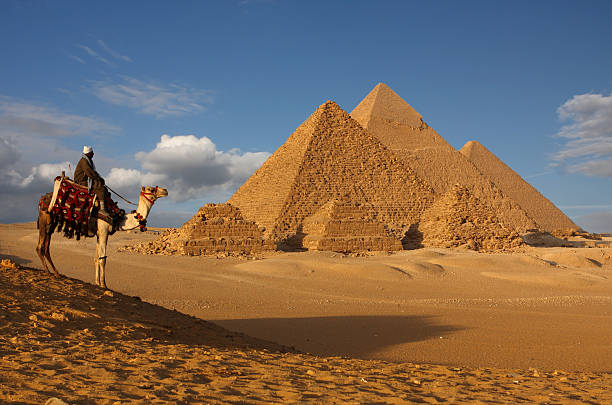
One of Egypt’s greatest mysteries is how these Egyptian pyramids were built, but one known fact is that the Giza pyramids were built to withstand an eternity of wear and tear, and they have done just that. The massive tombs are relics of Egypt’s Old Kingdom era, dating back 4,500 years.
To prepare for the next world, Egyptian pharaohs who believed they would become gods in the afterlife-built temples to the gods and massive pyramids for themselves. These temples were stocked with everything a king would need to survive in the afterlife. Unfortunately, all three pyramids were plundered both internally and externally during ancient and medieval times. As a result, the grave goods that were originally deposited in the burial chambers have vanished, and the pyramids no longer reach their original heights due to the removal of the majority of their smooth white limestone outer casings. The pyramids’ names, Khufu, Khafre, and Menkaure, correspond to the kings for whom they were built.
Khufu’s son, Pharaoh Khafre, the fourth king of the 4th dynasty, built the second pyramid at Giza. The Khafre pyramid stands 707.75 feet (216 metres) tall on each side and was originally 471 feet (143 metres) tall. Menkaure’s pyramid was the southernmost and last to be built; each side measures 356.5 feet (109 metres), and the total height of the structure was 218 feet (66 metres). It was much smaller than the first two, but it had a far more intricate mortuary temple. There are also subsidiary pyramids nearby where other royal family members are buried.
Nubian Pyramids (Sudan)
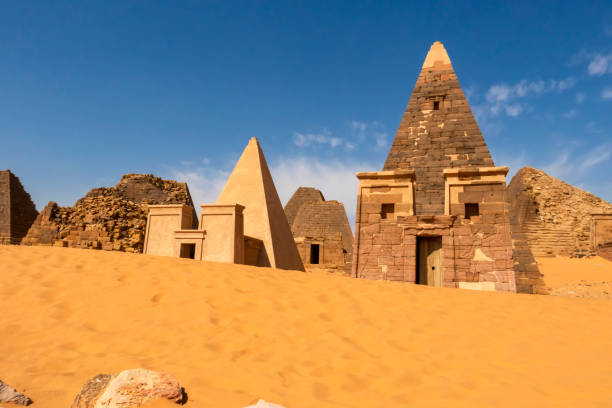
The Nubian Meroe Pyramids, which are much smaller but just as impressive as the more famous Egyptian pyramids, are located in Nubia, Sudan, near the banks of the Nile River. The pyramids were named after the ancient city of Meroe, which served as the capital of the ancient African Kingdom of Kush.
Following the fall of the 24th Egyptian dynasty around 1000 BCE, the Nubian Kingdom of Kush arose as the dominant power in the middle Nile region. From 712 to 657 BCE, the Kushite kings took over and ruled much of Egypt. When the kingdom’s capital and royal burial ground moved to the Mereo region in 300 BCE, the tradition of building pyramids to encase the tombs of the kings began.
The Nubian Meroe pyramids are the best preserved of all the Sudanese pyramids because they are the final resting place of more than 40 Nubian Kings and Queens of the Kush kingdom. However, over time, these pyramids have been robbed of all their wealth. The Italian explorer Giuseppe Ferlini, who alone smashed the tops of 40 pyramids in a quest to find their treasures between 1800 and 1870, was a popular plunderer of these sacred sites. However, the majority of his loot has been returned to museums in Germany and the United Kingdom. This architectural gem appears to have been forgotten by the modern world, nestled between sand dunes more than 200 kilometers from Sudan’s capital, Khartoum, as the site records fewer and fewer visitors.
The Great Mosque of Djenne, Mali.

Arriving in Djenne, Mali’s ancient pilgrimage city known for its distinctive earthen architecture, the majestic Great Mosque of Djenne can be seen from afar against the horizon, dwarfing the immediate neighborhood of low-rise adobe houses around it. The mosque, which was rebuilt in 1907, is one of Africa’s most revered religious monuments. It is the largest surviving example of a distinct style of African architecture, constructed almost entirely of sun-dried mud bricks coated with clay.
According to legend, the original Great Mosque was built in the 13th century by King Koi Konboro, Djenne’s twenty-sixth ruler and first sultan (king), who decided to build a place of Muslim worship in town using local materials and traditional design techniques. The mosque was expanded and surrounded by a wall by King Konboro’s successors and the town’s rulers. The mosque compound grew over time, and by the 16th century, popular accounts claimed that half of Djenné’s population could fit inside the mosque’s galleries.
The current Great Mosque of Djenne is the third reconstruction, completed in 1907. The roof has several holes covered by terra-cotta lids that allow fresh air into the interior spaces even on the hottest days. The Great Mosque has three minarets on its façade, and at the top of the minarets are conical extensions with ostrich eggs placed at the very top, which represents fertility and purity in the Malian region. Timber beams on the exterior are both decorative and structural, serving as scaffolding for the re-plastering of the mosque during the annual Crepissage festival. During this festival, the entire city participates in the re-plastering of the mosque’s exterior by kneading a mud plaster made from sand into it.
The current Great Mosque features several innovations, including a special court for women and a main entrance with earthen pillars marking the graves of two local religious leaders. This transcendent earth-made art was designated a UNESCO World Heritage Site in 1988 and is regarded as the finest example of Sudano-Sahelian architecture.
Great Mosque in Porto-Norvo, Benin.

The Great Mosque in Porto-Norvo, Benin, is an architectural marvel. The mosque’s construction began in 1912 and was finished in 1925. Today, the structure is a recognized historical landmark that draws visitors from all over the world.
The building is odd in that it looks like a chapel despite being a mosque. Vegetable and scrolled stucco moulding decorates the front façade.


